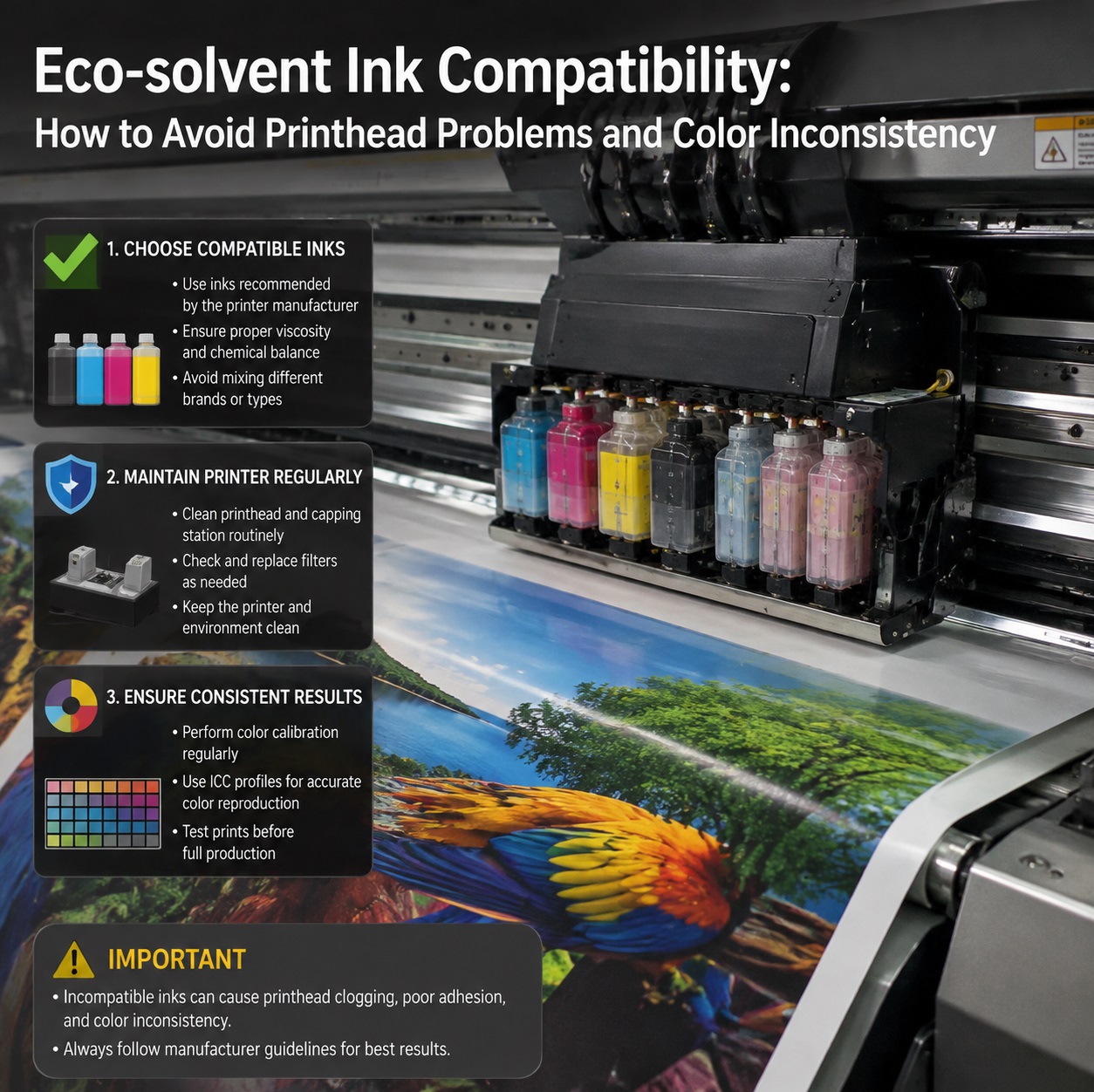
 A clogged printhead at 2 a.m. is not a maintenance issue. It is a hostage situation. You have a deadline, a customer who already approved the proof, and a machine that suddenly prints half a nozzle check. Nine times out of ten, the root cause is not the printer. It is the relationship between the ink and the printer, the chemistry, the cartridge, the profile, the environment, and the way all of those things were matched before the first drop hit the media.
Eco-solvent ink is a broad category, not a universal fluid. Two inks can both say eco-solvent and behave like distant cousins. One may run clean in a DX5 head for months. The other may swell a damper, drop out on cyan, and shift reds toward orange by lunch. That is why compatibility has to be treated as a system, not a checkbox on a spec sheet.
Start with the printhead, not the printer model. Epson DX5 or Ricoh Gen5 is not enough detail. You need to know the exact head generation, the ink path materials, the damper and cap design, and the firmware ink limits. A supplier who asks only for your printer name is not doing compatibility engineering. They are guessing. The good ones ask about your capping station, your wiper, your cleaning cycle, your typical daily volume, and the media you run most.
Then look at the ink itself. Viscosity, surface tension, particle size, and filtration are not lab trivia. They determine whether the ink forms a stable meniscus at the nozzle, whether it flows through a fine damper, and whether pigment particles stay suspended or settle into a soft sludge. If a batch drifts on any of those numbers, you get misfires, deflections, and banding that no amount of cleaning will fix. Color inconsistency often starts here, long before ICC profiles enter the conversation.
The dirty secret of color drift is that many print shops blame the profile when the ink batch changed. A profile is a snapshot. It captures the behavior of one ink, one media, one printer, one environment, and one day. If the next ink batch has a slightly different pigment load or solvent balance, the same profile can push density too high in shadows and flatten midtones. You see it as muddy greens, weak reds, or a black that looks brown under store lights. The fix is not to keep tweaking the profile until it looks acceptable on one job. The fix is to demand batch-to-batch consistency and re-linearize when a new lot arrives.
Switching inks is where most printhead disasters happen. People flush with a generic cleaner, swap cartridges, and run a nozzle check. That is not a switch. That is a gamble. Different eco-solvent formulations can react with each other. Resins can fall out. Solvents can swell seals. Pigments can agglomerate into particles large enough to block a nozzle. If you are changing brands or even changing from one formulation to another, use a proper line flush, replace dampers and caps when recommended, and purge the system with the new ink before you put production media on the platen. The cost of a few cleaning cartridges is nothing compared to a new printhead.
Environment matters more than most operators admit. Eco-solvent inks are designed to work within a temperature and humidity window. A shop that is 15°C in the morning and 30°C by afternoon will see viscosity change, drop volume shift, and drying behavior move around. That shows up as color inconsistency across a long run, especially in gradients and skin tones. Keep the print room stable. Keep media acclimated. Keep your capping station clean and your wiper in good condition. A printhead that sits dirty overnight is a printhead that starts tomorrow with a handicap.
Inventory discipline is unglamorous and powerful. Ink has a shelf life. It does not like heat, direct sun, or freeze-thaw cycles. Rotate stock. Use older lots first. Record lot numbers on every job. If a customer complains about a color match three weeks later, you want to know which ink batch produced the original print. Without that traceability, you are arguing from memory. With it, you can isolate the variable and fix the process.
Before you commit a full roll, run a compatibility test. Print a nozzle check, a small color patch set, and a gradient. Let it sit. Check for drying, coalescence, and adhesion. Then compare the color to your reference under the same lighting the customer will use. This sounds basic because it is. Basic done consistently beats advanced done occasionally.
The marketing lesson is simple: print shops do not buy ink. They buy uptime, repeatable color, and fewer emergency calls. An eco-solvent ink that saves a few dollars per liter but costs you a printhead and a reprint is not cheap. It is expensive in disguise. The right supplier will talk about batch data, printhead compatibility, flushing procedures, and profile support before they talk about price. That is the partner who keeps your nozzles firing and your reds red.
If you want to avoid printhead problems and color inconsistency, stop treating compatibility as a line item. Treat it as a chain. The printhead, the ink, the cartridge, the damper, the profile, the environment, and the operator all have to agree. When they do, eco-solvent printing is one of the most reliable and profitable production methods in the shop. When they do not, you will meet your printhead far more often than you want.