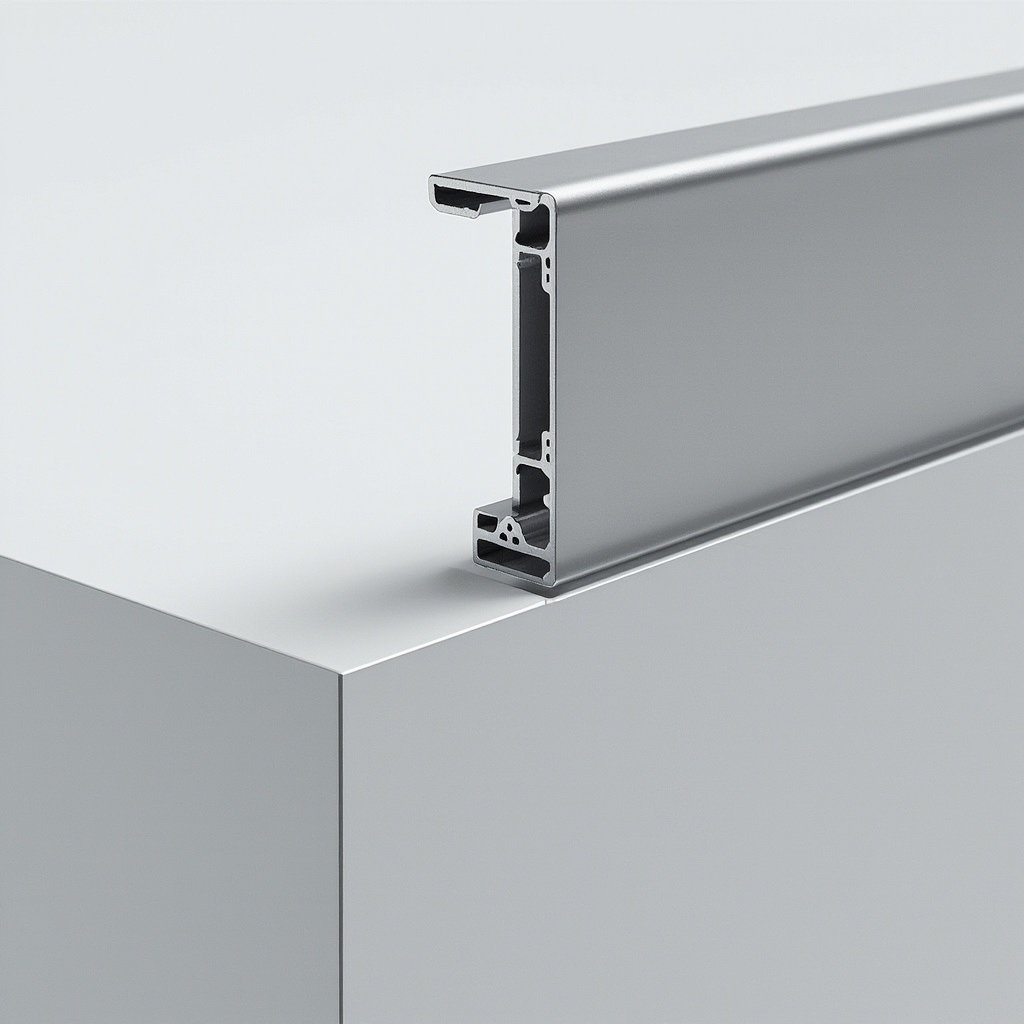
 You spent a fortune on those sleek, ultra-thin aluminum baseboards. They were supposed to snap into place and make your renovation look like a million bucks. Then the installer arrives, the first piece goes up, and you see it: a gap. Not a tiny hairline crack, but a wavy, ugly void between the baseboard and the wall. The culprit isn’t the product. It’s your wall.
Ultra-thin aluminum baseboards are the darlings of modern interior design. They offer a razor-sharp, minimalist line that traditional wood or MDF can never achieve. But here is the brutal truth that no one tells you: these beautiful, rigid strips have zero forgiveness. Wood bends. MDF flexes. Aluminum? It laughs at your uneven drywall and then leaves a three-millimeter gap to mock you.
Let’s talk about wall flatness deviations. In the construction world, a standard wall might have a tolerance of 1/4 inch over 10 feet. That is a massive wave. For a thick wooden baseboard, you can caulk it, sand it, and paint it. Problem solved. For an ultra-thin Aluminum Alloy Baseboard, that same 1/4 inch deviation is a disaster. The aluminum profile is engineered to sit flush. It doesn’t “give.” When your wall dips, the baseboard stays straight. The result is a shadow line that screams “cheap renovation” louder than any bargain-bin material ever could.
Why does this happen? The physics are simple. A thin aluminum extrusion has a high moment of inertia in its vertical axis but almost none in its horizontal axis against the wall. It is designed to be a straight edge. If your wall has a convex bump, the baseboard will rock on that bump, leaving gaps on either side. If your wall has a concave dip, the baseboard will bridge the gap, leaving a hollow space behind it that catches dust and looks terrible.
So, what is the solution? You have two choices. One: spend weeks mudding and sanding your walls to a mirror finish before installation. That is expensive, messy, and frankly, most contractors won’t do it right. Two: choose a product that actually solves the problem.
This is where our premium ultra-thin aluminum baseboard system changes the game. We didn’t just make a pretty piece of metal. We engineered a hidden, adjustable clip system that compensates for wall imperfections. Our patented mounting brackets allow for micro-adjustments of up to 5 millimeters. You can screw the bracket deeper into the stud where the wall is fat, or shim it out where the wall is thin. The baseboard then clips onto a perfectly level track, not the wall itself.
This means your installer can fix a 1/4 inch deviation in seconds. No caulk. No gaps. No headaches. The final look is a laser-straight line that runs from corner to corner, regardless of how lumpy your drywall is.
Don’t let a poorly finished wall ruin the look of your high-end renovation. You are buying ultra-thin aluminum for the precision, the durability, and the modern aesthetic. Demand a system that respects that investment. Stop fighting your walls. Start fitting them perfectly.